


Customer Value Is Becoming Infrastructure
.png)
When I was Chief Product Officer at Workday, we had a sizable value engineering team. Smart, experienced people who built rigorous business cases for our largest deals.
They touched maybe 5% of our opportunities.
That wasn't a staffing problem. It's the nature of the work. Value engineering as practiced today is a craft: scarce experts building bespoke ROI analyses, one deal at a time, in spreadsheets that die the moment the deal closes. The other 95% of deals get whatever the account executive can cobble together from old decks and tribal knowledge.
And that's at a company with the resources to fund the function at all. Most companies have nothing.
A Problem That's About to Get Existential
For the past two decades, this was an inefficiency you could live with. Software markets were growing, switching costs were high, and a good product with a decent pitch could win.
That era is ending.
AI is making features cheap to build and cheaper to copy. Buyers can increasingly see for themselves whether a vendor delivered. Budgets are shifting from seats to outcomes, and even the foundation model companies are being asked to prove the productivity gains they promise.
When every feature can be replicated in a quarter, proven value is the only defensible thing left to sell.
But here's the uncomfortable part: almost no company has a system for it. There's no shared definition of customer value, no consistent way to measure it, and no connection between what was promised during the sale and what was actually delivered after go-live. The knowledge lives in decks, spreadsheets, CRM fields, call transcripts, and people's heads — and it walks out the door with every rep who leaves.
Go-live used to be the finish line. Now it's the starting line for proving the customer got what they paid for. That's not a workflow problem — it's an infrastructure problem, because the proof has to persist and compound long after the deal team moves on.
What Minoa Built
This is exactly the kind of problem that fits Storm's investment thesis: a large, mission-critical function locked behind scarce, expensive human expertise. AI doesn't just make that function more efficient — it replaces the services spend behind it and scales the skillset to every B2B company, not just the ones who could afford to build the team.
Minoa is the system companies use to define, sell, deliver, and prove customer value across the full customer lifecycle. Account executives generate executive-ready business cases without a value engineer at their side. Account managers walk into renewals with the realized value on the table. Sales leaders pressure-test pipeline against quantified value instead of rep narrative.
What convinced me wasn't the workflows — it was the architecture underneath them.
Every deal, every value driver, every accepted assumption, every promised and realized outcome feeds a knowledge graph that gets smarter with use. A one-off AI-generated business case has no memory. It doesn't know what your company promised this customer eighteen months ago, which assumptions their CFO accepted, or how this account compares to the last twenty like it. Minoa does.
That's the recipe I look for in this era: a compounding data flywheel that sits below the compression line — the structured intelligence layer AI agents will call, not an interface layer AI will replace.
The Buyers Who Know This Problem Best Have Already Decided
The most sophisticated value organizations in software looked at this problem and chose Minoa.
Snowflake evaluated building it internally and instead rolled Minoa out to thousands of sellers. Vanta went from one user to more than a hundred within their first contract. Pendo ran an exhaustive competitive evaluation and chose Minoa — and saw win rates climb meaningfully where Minoa is attached. Ironclad's president describes Minoa as core infrastructure for their shift toward outcomes.
And then there's Cognite, whose CEO stood on stage and committed to creating $100 billion in customer value by 2035 — measured on Minoa. In June, Schneider Electric announced an agreement to acquire Cognite. The company that made customer value its North Star, with Minoa as the backbone, just validated the thesis in the most concrete way possible.
Founder–Market Fit You Can Feel
Max Elster and Richard Einhorn landed those logos with a team of six and minimal capital — as German-born founders who relocated to Silicon Valley and built their credibility deal by deal within the enterprise GTM community.
Max has the rare instinct for entering through a structurally defensible buyer that competitors ignored. Richard built production-grade knowledge graph infrastructure at a stage when most companies have a roadmap slide. The architecture isn't aspiration — it's running, multi-tenant, inside some of the most demanding software companies in the world.
Where This Goes
Value selling isn't a software problem. It's an every-industry problem — anywhere a company sells a complex investment and then has to prove it was worth buying. Software today; AI, hardware, and professional services next.
As pricing shifts from seats to outcomes, the companies that can prove the value they deliver will keep and grow their customers. The ones that can't will become easier and easier to replace. Every company will need a system of record for customer value.
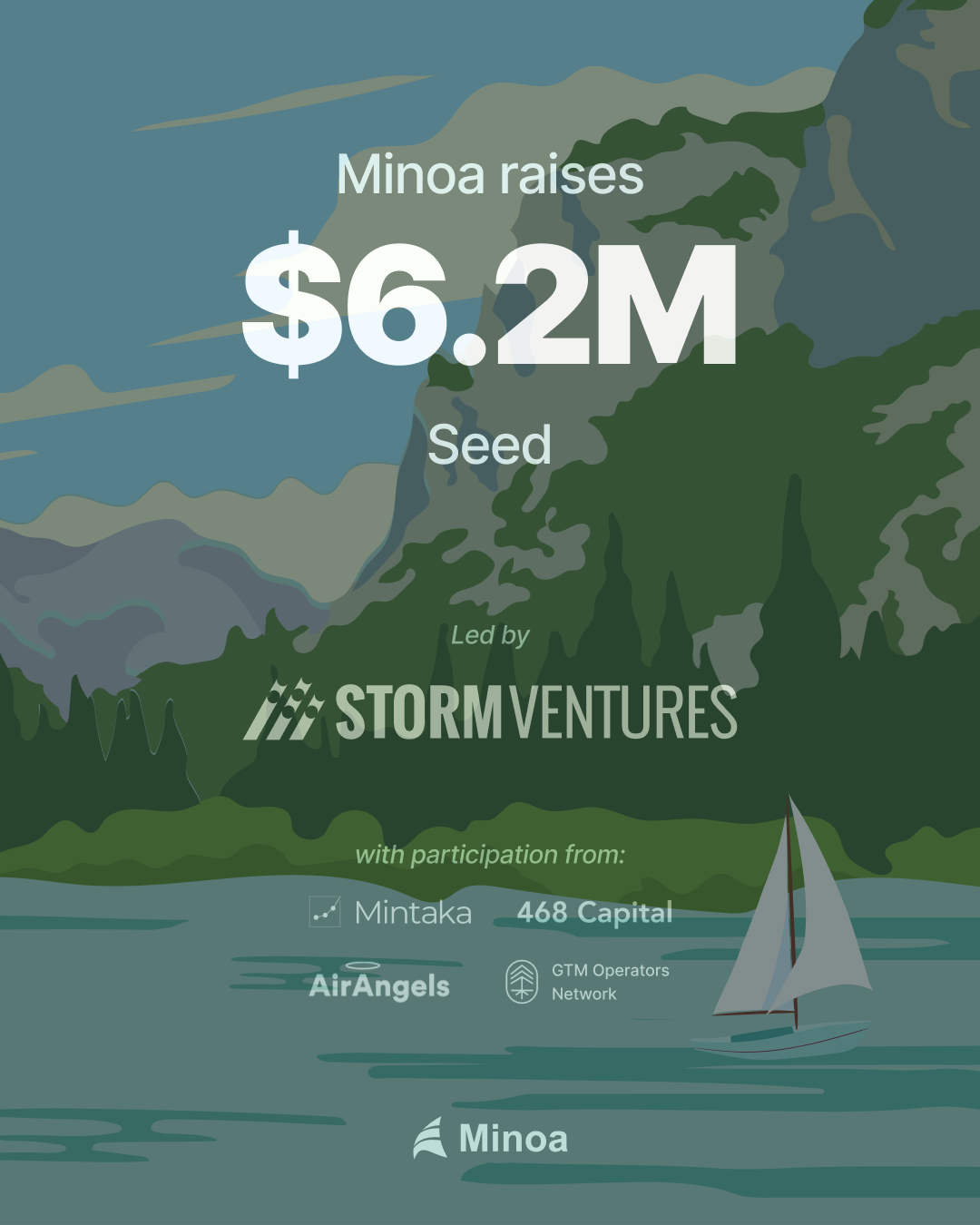
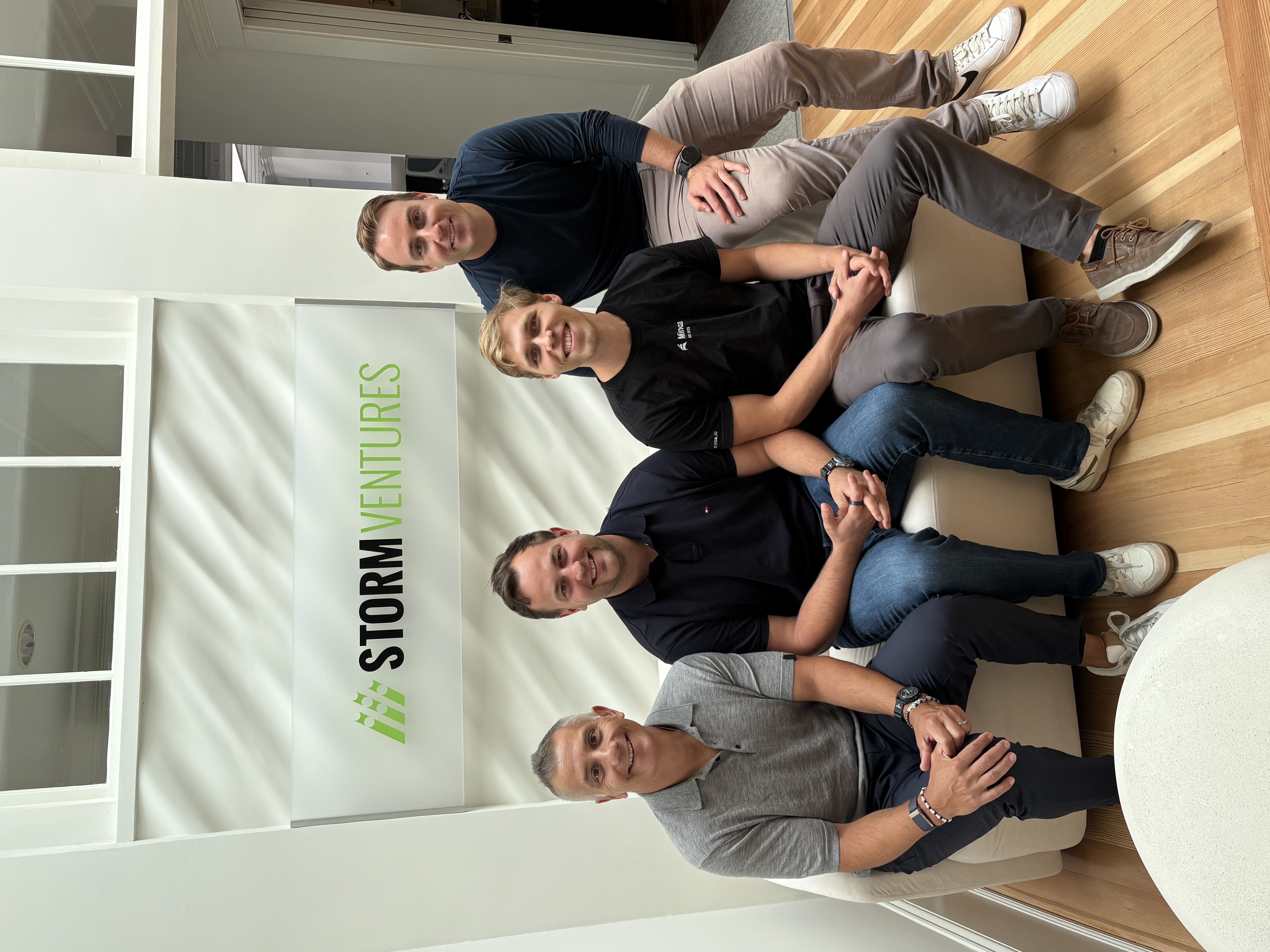
We believe Minoa is that system, and we're proud to lead their $6.2M seed round.
“Storm combined the two things we cared about most: decades of experience building category-defining enterprise software companies and a team willing to work alongside us from day one. David’s experience as Workday’s former Chief Product Officer gave him an immediate understanding of our vision, and their hands-on support made the decision clear.” - Max Elster
Value is becoming the only thing left to sell. Minoa is how you prove it.